Six mistakes to avoid when choosing an HCM or WFM supplier
Nobody wants to change their HR tech for the sake of it, whether that is an HRIS or HCM platform (human resources information system or human capital management: HR, payroll, recruitment) or a WFM platform (workforce management: rostering, time and attendance, leave). Organisations change because something is not working: the system cannot cope with how they operate, the supplier is not delivering what was promised, or the workarounds have taken over. Changing is disruptive, it is expensive and it touches everyone's pay, which is why most organisations only do it once a decade. So when you do change, you want to change once and get it right.
The suppliers you are choosing between, often called vendors, sell a platform every week. They know where their product is strong, where it has gaps and which parts of the demonstration to move through quickly. Here is how to avoid falling into the trap.
1. Going straight to the demonstration
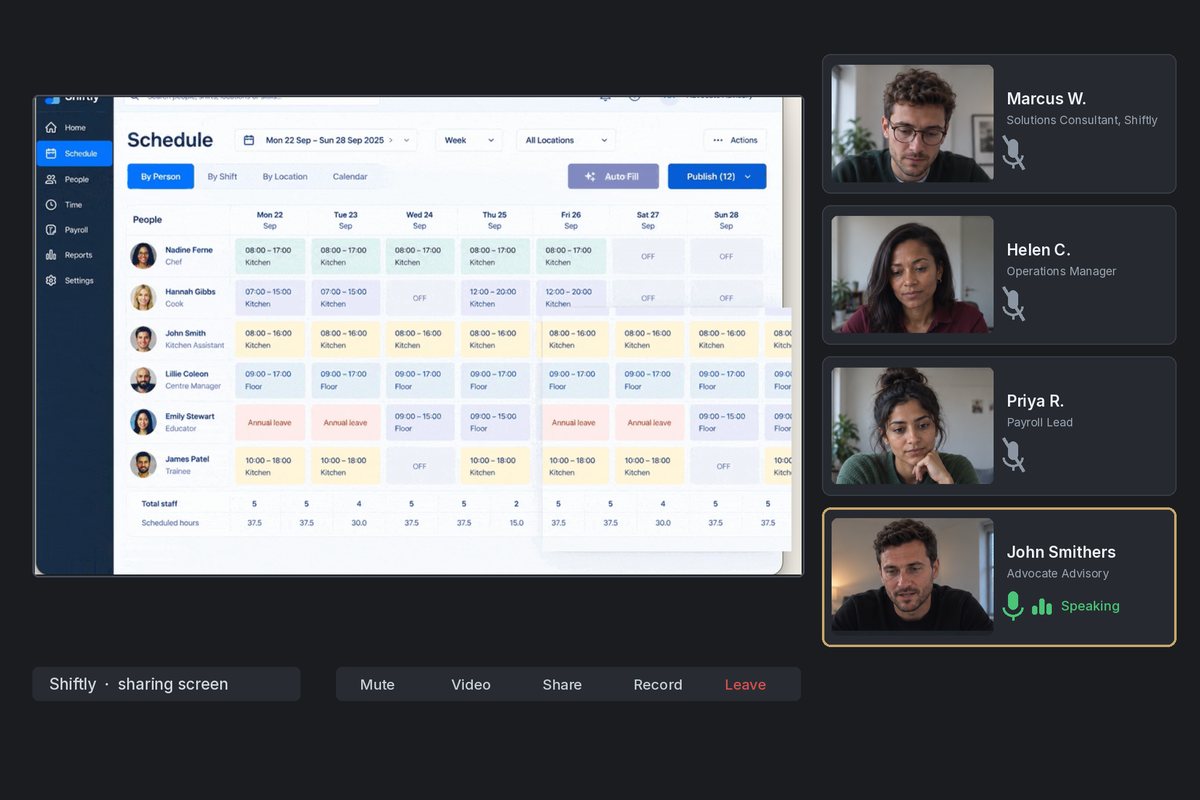
When things are not working, or you have never had a system and the spreadsheets are creaking, the natural move is to book three suppliers in and see what is out there.
Resist it. A demonstration watched before you know your own requirements tells you what the supplier is good at, and very little about whether the platform fits you. Take a step back. The work in the next four sections is what turns a demonstration from a show into a test.
2. Skipping the as-is
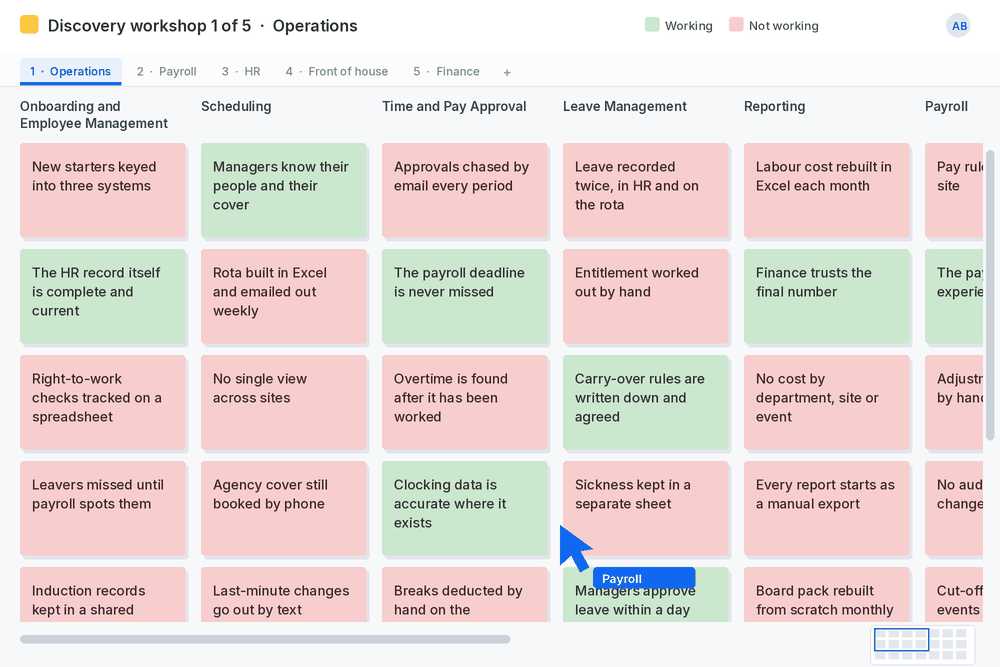
Before you look at anything new, understand how things work now - the as-is - department by department:
- what is unique to each department
- what works well and must not be lost
- where the challenges are
Then ask why. Why do people do it that way? Listen out for "that's the way we've always done it". It usually marks a workaround for something the current system never handled, which makes it exactly what the new one will need to handle.
Give everyone an equal voice. The loudest people in a workshop are rarely the ones doing the most manual work. The quieter voices often are.
Dig into the teams who say their requirements are simple. They often are not. "We just need to schedule employees" tends to unpack into something far more complex than a rota.
3. Carrying old quirks into a new system
Most organisations collect exceptions over the years: old contracts still honoured, leave rules that differ by site, benefit rules nobody wrote down, pay rates and rules that vary for historical reasons. Each one has to be configured, tested and maintained in the new platform, and each one adds admin. A new system does not remove the pain of a quirk. At best it automates it, at a cost. At worst it clouds the configuration and makes every future change harder.
Standardise what you can before you go to market. It is harder once a supplier has quoted for the complexity, and harder still once it is configured. Anything contractual needs HR involved early, so start that conversation first. Future you will thank you for it.
4. Not playing it back
Once you have gathered the as-is, play it back to each team. Show them what you heard and ask one question: have I missed anything? Playback catches the misunderstandings that would otherwise surface in testing, when they are expensive to fix.
Then ask each department to sign off. Sign-off makes each team accountable for its own requirements, and it stops "nobody asked us" arriving six months into the project.
5. Making everything a Must
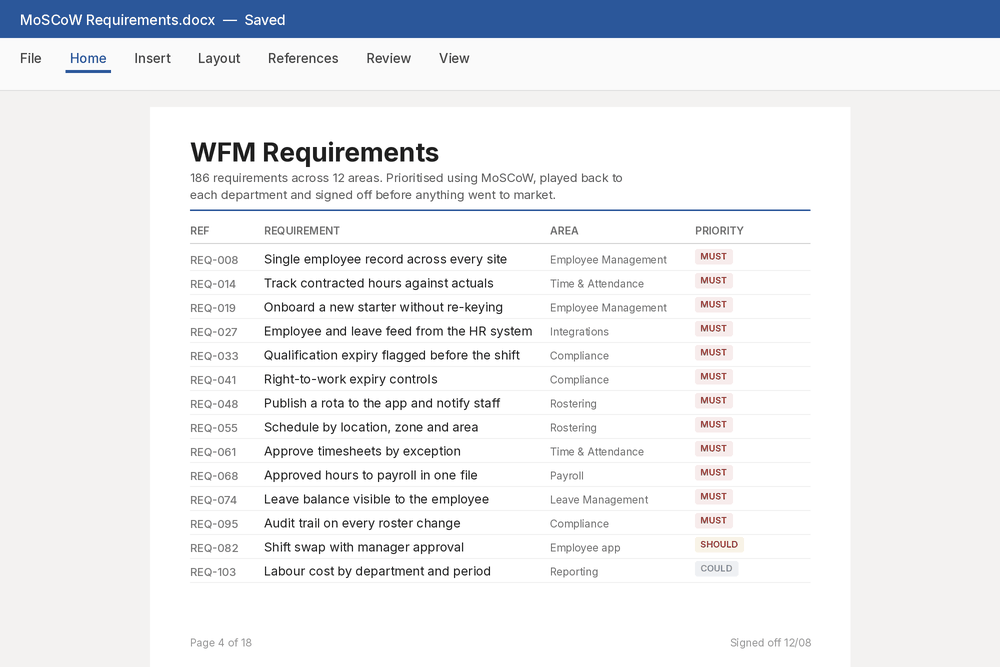
MoSCoW sorts requirements into Must have, Should have, Could have and Won't have (this time). It only works if the Musts are rare. A list with 50 Musts is not realistic. No platform will meet it, and it gives you no way to tell suppliers apart.
Point the Musts at the manual work you are trying to remove. Look for the places people do things twice:
- HR keying a change into one system, then amending another by hand
- new starter details adjusted after they have been set up
- leavers processed manually in more than one place
- contract changes that do not flow through to payroll or rostering
That duplicated work is where the time and the errors are, and it is what a new platform should be judged against.
6. Letting the supplier run the demonstration
A supplier will show you what you want to see in a vendor demonstration. That is their job. Yours is to make them show you what you need to see.
Put the work from the first five steps to use. Send your scenarios in advance and ask to see them working, in detail, rather than on a slide:
- How is a leave balance created for a new starter on one of your non-standard contracts?
- Can it handle the quirks you could not standardise?
- Can it produce the reports you need?
If the answer is "yes, that's configurable", ask to see it configured. Write down what was shown, what was promised and what was deferred, and hold them to it at contract.
Where to start
The order is as-is, standardise, play back, prioritise, then demonstrations. Our Supplier Selection service follows those steps from the first workshop through to scoring and a decision. If you already have a platform and are not sure whether the problem is the platform or everything around it, start with the HCM & WFM Health Check.
Let’s Talk About What You’re Dealing With
Whether you're selecting a WFM platform, implementing one, fixing a project that's gone off track, or getting more from what you already have, a short conversation is the best place to start.
Tell us what's happening. We'll give you an independent view of the problem, whether we can help, and what to do next.
Talk Through Your Problem (opens in new tab)
30 Minutes. No Obligation. No Supplier Agenda.